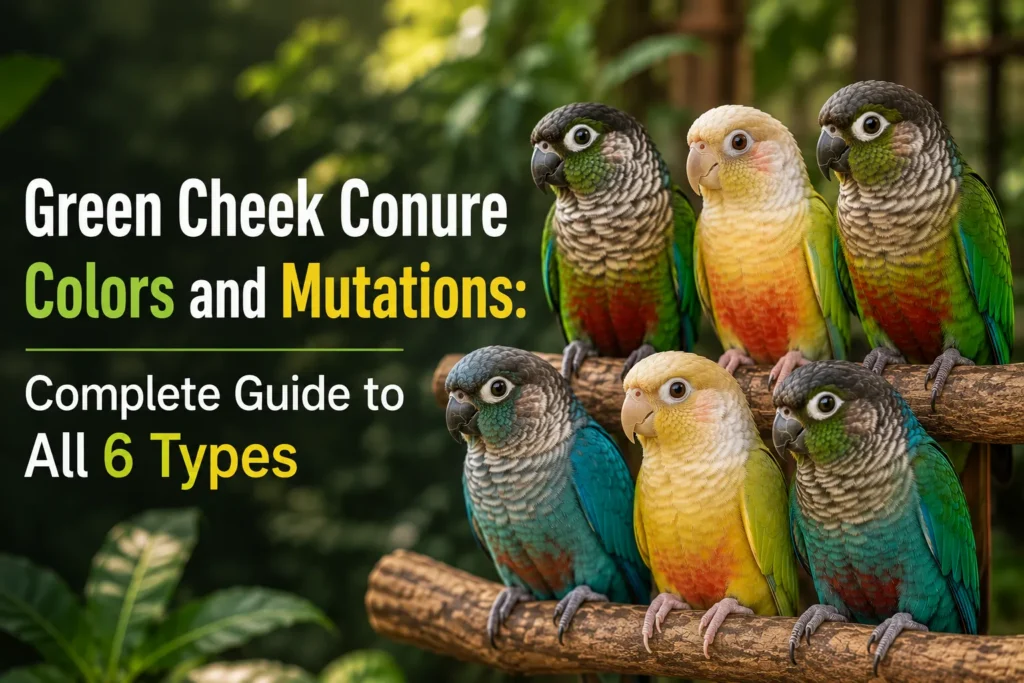
Green Cheek Conure Colors and Mutations: Complete Guide to All 6 Types
If you have decided a Green Cheek Conure is your next parrot, the next question is which colour. Selective breeding over the past three decades has produced six distinct colour mutations that dramatically change the bird’s appearance without changing its personality, care requirements, or lifespan. This guide walks through all six main Green Cheek Conure colour mutations, what they look like, what they cost, and how to identify each one at a glance.
Ready to bring one home? Browse conures for sale at Mo’s Birds to see which birds are available now.
What is a Green Cheek Conure colour mutation?
A colour mutation is a genetic variation that changes the pigmentation of a bird’s feathers without affecting its species. All Green Cheek Conure colour mutations are Pyrrhura molinae, the same species as the wild type Normal Green Cheek. Color names do not establish an individual bird’s temperament or health. Confirm its identity, history and care needs.
The 6 main Green Cheek Conure colour mutations
1. Normal (Wild Type Green Cheek)
The classic look. Bright green body, dark maroon tail, grey chest with soft barring, and characteristic green cheek patches that give the species its name. This is the appearance the species has in the wild across Bolivia, Argentina, Paraguay, and Brazil. Prices run $275 to $400 for a hand raised baby.
2. Yellow Sided
First developed in the mid 1990s. Bright yellow to golden orange sides and belly replace the grey of a Normal, while the back and head remain green. The tail retains the maroon of the Normal. Yellow Sided Green Cheeks are one of the most popular colour mutations because the yellow highlights make the bird more visually striking without changing its overall silhouette. Prices $350 to $550.
3. Cinnamon
A softer, warmer version of the Normal. The base green is replaced with a lime to yellow green, and the maroon tail becomes bright cinnamon red. The head is slightly paler than a Normal. Cinnamons look almost pastel compared to Normals. Prices $350 to $550.
4. Pineapple (Cinnamon Yellow Sided)
A combined mutation crossing Cinnamon with Yellow Sided. The result is one of the brightest, most colourful Green Cheeks: yellow to golden orange sides on a soft lime green base with a bright red tail and pale head. Pineapples are widely considered the most visually striking of the standard Green Cheek mutations. Prices $450 to $650.
5. Turquoise
A completely different base colour. Instead of green, the Turquoise mutation produces a soft blue green body with pale grey chest and a dark tail. First established in the late 2000s. Turquoise Green Cheeks are less common than the green based mutations and typically command higher prices. Prices $500 to $750.
6. Suncheek
The rarest of the commonly available mutations. Mutation names can be used inconsistently in listings. Ask the breeder for the bird’s confirmed mutation and parentage rather than inferring genetics from a marketing label. Suncheeks are the brightest and most unusual looking Green Cheeks in the pet trade. Prices $650 to $800 or higher.
Green Cheek Conure colour mutation price table
| Colour Mutation | Base Colour | Price Range (2026) |
| Normal | Green with maroon tail | $275 to $400 |
| Yellow Sided | Green with yellow sides | $350 to $550 |
| Cinnamon | Lime green with red tail | $350 to $550 |
| Pineapple | Lime yellow with red tail | $450 to $650 |
| Turquoise | Soft blue green | $500 to $750 |
| Suncheek | Turquoise with yellow sides | $650 to $800 plus |
At Mo’s Birds we hand raise several Green Cheek colour mutations. To see currently available babies, visit our Green Cheek Conure product page or the full conures category page.
Do colour mutations affect personality or care?
No. All Green Cheek Conure colour mutations are the same species (Pyrrhura molinae) with the same species-level housing, diet and enrichment needs. Individual temperament, noise and health vary, so a mutation is not a guarantee of behavior. For noise details specifically, see our Green Cheek Conure noise breakdown.
Are certain colour mutations healthier than others?
Color alone is not a health assessment. Ask about parentage, individual health history and available testing, and arrange an avian veterinary examination.
How to choose the right Green Cheek colour
Choose Normal if: you want the classic Green Cheek appearance at the most affordable price.
Choose Yellow Sided if: you want visual pop with a mainstream colour that photographs well.
Choose Cinnamon or Pineapple if: you love the softer pastel look and warmer tones.
Choose Turquoise or Suncheek if: you want the most unusual and eye catching bird and don’t mind paying more.
How to identify a Green Cheek Conure colour mutation
The three quickest identification checks:
- Look at the sides and belly. Grey means Normal. Yellow means Yellow Sided or Pineapple. Turquoise means either the Turquoise or Suncheek mutation.
- Look at the tail. Dark maroon means Normal or Yellow Sided. Bright red means Cinnamon or Pineapple. Dark blue tinged means Turquoise or Suncheek.
- Look at the base body colour. Bright green means Normal or Yellow Sided. Lime yellow means Cinnamon or Pineapple. Soft blue green means Turquoise or Suncheek.
Where to buy a Green Cheek Conure
DNA sexing and individual disease testing are optional add-ons. Ask Mo which records are available for the specific bird and what is included before reserving. Related: Green Cheek Conure page · new born babies page · contact Mo directly.
Frequently asked questions
Which Green Cheek Conure colour is the rarest?
Suncheek is currently the rarest of the commonly available mutations. Beyond the six main mutations, there are further rare combinations and dilute forms that command higher prices.
Do colour mutations affect lifespan?
No meaningful difference. All colour mutations of Green Cheek Conure live 20 to 30 years with proper care.
Which colour mutation talks the best?
None talk reliably. Green Cheek Conures are known for being quiet cuddlers, not talkers. All colour mutations share this trait equally.
Are Pineapple Green Cheek Conures friendlier?
Color alone does not predict friendliness. Meet the individual bird or ask for recent interaction videos and its handling history.
How can I tell if a Green Cheek is a Yellow Sided or a Pineapple?
Look at the tail. Yellow Sided birds have the dark maroon tail of a Normal. Pineapples have the bright red tail of a Cinnamon. That is the single fastest way to distinguish them.