
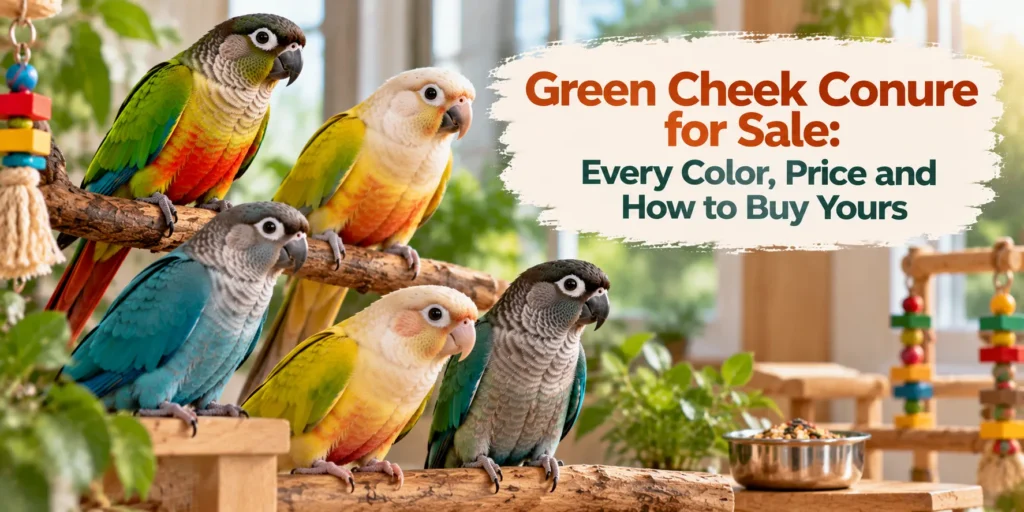
Green Cheek Conure for Sale: Every Color, Price and How to Buy Yours
The Green Cheek Conure has become one of the most popular parrots in the country, and it is easy to see why. It is small, cuddly, playful and far quieter than most conures. It also comes in a wide range of colors, from the classic green to rare pastel and sunset shades. If you are searching for a Green Cheek Conure for sale, the real question is usually which color to choose and what it costs. This guide shows you every color, the 2026 price, what is included with every bird and how to buy one.
Green Cheek Conures for sale: colors and prices
Every color is the same species and the same sweet personality. The difference is how much planning it takes to produce the color, and that is what drives the price. Mo’s Birds lists Green Cheek Conures starting at $274.99. You can see them on the Green Cheek Conure product page and browse every conure on the conures category page.
| Color | What it looks like | Typical Price 2026 |
| Normal | Wild type green with a maroon tail | $275 to $500 |
| Yellow Sided | Green with bright yellow sides | $350 to $600 |
| Cinnamon | Softer, warmer green and brown | $375 to $625 |
| Pineapple | Soft green back with a bright yellow belly | $425 to $700 |
| Turquoise | Blue green body | $500 to $800 |
| Turquoise Pineapple | Teal back with a yellow belly | $650 to $1,000 |
| Suncheek | Warm yellow and orange tones | $600 to $900 |
| Moon Cheek | Pale pastel with a blue tail | $600 to $1,200 |
For photos and full detail on each, read our Green Cheek Conure colors and mutations guide.
Moon Cheek Conure for sale
The Moon Cheek is the rarest and most requested color. It is a Green Cheek that carries several mutations at once, giving it a soft, pale, almost glowing look. You can see the current birds on the Moon Cheek Conure page and learn exactly what makes one a Moon Cheek in our Moon Cheek Conure guide.
Pineapple and Turquoise Pineapple conures for sale
The Pineapple is one of the most popular colors. It is a Green Cheek with a soft green back and a bright yellow belly. A Turquoise Pineapple adds a cool teal tone. See the current birds on the Pineapple Conure page and the Turquoise Pineapple page, and read the full story in our Pineapple Conure guide.
Suncheek, Cinnamon and Yellow Sided conures for sale
If you like a warm look, the Sun Cheek Conure has yellow and orange tones across the body. The Cinnamon Green Cheek has a softer, warmer shade. The Yellow Sided Green Cheek shows bright yellow on its sides and is one of the best value mutations.
What you get with every Green Cheek from Mo’s Birds
- A hand raised baby. Fed by hand and handled daily so it is tame and ready to bond.
- Disease testing. Ask Mo what records are available for the individual bird. DNA sexing and an individual disease panel are optional.
- DNA sexing available. So you know whether you have a male or a female.
- Pickup or delivery. Ask Mo for a delivery quote and carrier eligibility for the individual bird and your ZIP code. Southern California pickup is by appointment.
- Lifetime support. Mo stays reachable for questions for as long as you own the bird.
How to buy a Green Cheek Conure
- Pick a color from the table above, or ask Mo what is available now.
- Contact Mo and ask which babies are weaned and ready.
- Request recent photos and video of the exact bird.
- Confirm health testing and ask about DNA sexing.
- Confirm Southern California pickup or ask Mo to quote an eligible carrier and route.
- Set up the cage, food and toys before your bird arrives.
To start, contact Mo or call (310) 901-6896.
How shipping works for a Green Cheek Conure
Ask Mo for a delivery quote and carrier eligibility for the individual bird and your ZIP code. Southern California pickup is by appointment. See our shipping and pickup guide.
Are Green Cheek Conures quiet?
They are the quietest of the popular conures, which is why they work in many apartments and shared homes. They still make short contact calls, especially at dawn and dusk, and they will call out if they feel ignored. See the honest comparison in our Green Cheek Conure noise level breakdown and in our Sun Conure vs Green Cheek Conure guide.
Daily care for a Green Cheek Conure
- Cage: at least 24 by 24 by 36 inches, larger if possible.
- Diet: about 60 to 70 percent pellet, 20 to 30 percent fresh vegetables and a little fruit, with seeds and nuts as treats.
- Out of cage time: at least 2 to 3 hours each day.
- Enrichment: Offer foraging toys, safe shreddable materials and a suitable sleeping perch. See avian veterinary guidance on sleep huts.
- Sleep: 10 to 12 hours of quiet, dark sleep.
What does it cost in the first year?
- Cage: $250 to $600
- Perches, bowls and toys: $100 to $250
- Food: $300 to $500
- Avian vet: $200 to $500
- Emergency fund: $500 minimum
Is a Green Cheek Conure right for your home?
Green Cheeks suit many households. They are small, they do not need a huge cage and they are quiet enough for most apartments. They are also social, so they do best with someone home for a good part of the day or a routine that includes real time with the bird in the morning and evening. They can be playful and a little mischievous, and they will chew toys, paper and anything else within reach. Households with very young children should supervise all interactions, because a frightened conure can nip. If you want a loyal, funny, cuddly companion that fits a modest space, a Green Cheek is hard to beat.
Single bird or pair?
A single hand raised Green Cheek that gets daily time with its owner bonds closely and is often the cuddliest choice. A pair will bond to each other, entertain each other and may be less interested in handling. Some owners choose a pair so the birds have company while they are out. Either works, as long as you decide in advance, because the two options lead to different relationships.
What to look for in a healthy baby Green Cheek
- Bright, clear eyes and clean nostrils.
- Smooth, tidy feathers with no bald patches.
- An alert, curious posture and a willingness to step up.
- A good appetite and well formed droppings.
- Fully weaned and eating on its own.
Your first week with a Green Cheek
Keep the room calm and the routine steady. Offer the same food the bird ate at the aviary, then change it slowly. Cover the cage at night for 10 to 12 hours of sleep. Sit near the cage, talk softly and offer small treats through the bars. Most Green Cheeks settle fast and soon begin to greet you, bob their heads and ask for attention, which is a sign that the bond is growing.
Which Green Cheek color should you choose?
- Best value: Normal or Yellow Sided.
- Most popular look: Pineapple.
- Cool toned and unusual: Turquoise or Turquoise Pineapple.
- Rarest: Moon Cheek.
Looking at other conure species too? Our conure price guide compares them all, and the conures for sale page shows every conure we list.
Questions to ask before you buy
- Is the bird fully weaned and eating on its own?
- Which exact color and mutation is it, and can I see the parents?
- Has it been health tested, and can I see the results?
- How and when will it be delivered?
Ready to buy a Green Cheek Conure?
See the birds on the Green Cheek Conure product page, check the new born babies page, or contact Mo with your questions.
Frequently asked questions
How much is a Green Cheek Conure for sale?
A Normal Green Cheek starts at $274.99 at Mo’s Birds. Color mutations run $350 to $1,200 depending on rarity.
Which Green Cheek color is the rarest?
Moon Cheek and Turquoise Pineapple are among the rarest, because they combine several mutations in one bird.
Are Green Cheek Conures loud?
They are among the quietest conures. Like all conures they call out for attention, but they are much quieter than Sun or Jenday Conures.
Does color affect personality?
No. Every Green Cheek color has the same personality, size, noise level and lifespan.
Do you ship Green Cheek Conures?
Ask Mo for a delivery quote and carrier eligibility for the individual bird and your ZIP code. Southern California pickup is by appointment.
How long do Green Cheek Conures live?
Typically 20 to 30 years with good care.