Tips for training session success!
Choosing the correct reinforcer for the learner you are working with is critical to session success!
In order to understand how best to choose a reinforcer for your parrot, it is important to understand WHAT a reinforcer is!
A reinforcer is a consequence for behaviour that will INCREASE the probability that the target behaviour will occur again in future.
If a behaviour does not maintain or increase in frequency then what we are using to reinforce that behaviour is not considered by your learner to be reinforcing. Instead it may just be something that they enjoy or find pleasant, but otherwise are not willing to work to get access to.
What is reinforcing for your learner is entirely up to them. We cannot force them to want to work for something because we believe they should.
Additionally what is reinforcing for your parrot may change depending on the day, time, location of your training session, distractions in the environment…amongst other things. For this reason it is important to have a ‘tool kit’ of various reinforcers we can use for our bird which we can switch to as needed.
Some potential reinforcers are shown below, this is not an exhaustive list:
• Nuts
• Seeds
• Fruits
• Tactile affection like head scratches
• Play time or toys
• Verbal praise / attention
For training purposes it is often best to start with an item that allows for quick repetitions, especially in the early stages. This is why we often favour food items to start with. When offered in an appropriate size your bird can quickly eat a small piece of food and then they are ready for the next repetition of the behaviour. Additionally food provides lots of possible variety / choices, it is high value, easy to carry with you and boosts positive associations with you and your training!
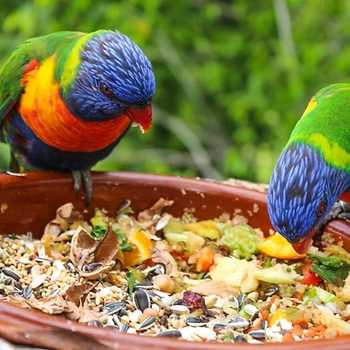
So how do we identify possible food reinforcement for your bird? Simple! What is the first thing your bird eats when you offer them a bowl of food? This is often one of their favourite items. Hint: Usually it’s the food they should only have in small quantities!
If you do not offer nuts / seeds / fruits regularly from bowls, or you aren’t sure what they favour then you can set up a ‘sample’ plate of various food items for them and make note of the items they choose first and eat the most of from the plate!
You can also take note of the items they are the most excited for! Is there a food item they’ll do just about anything to get their beaks on? Great! This is most likely a reinforcer for your parrot!
Check out this video we created on identifying food reinforcers for more info: https://youtu.be/fp1mbzm9-_U
Tip #4 – Have a training plan!

Do you know what you are going to be training your bird to do? Do you know what that behaviour looks like? Do you have steps in mind to get from where you are to your behaviour goal?
A training plan helps you to clarify exactly what your goal behaviour is and then visualise each step of the process to achieve your target behaviour.
A training plan gives you and your bird small, achievable goals to work towards. This process clarifies in your mind what you want to achieve in each training session! This is important because if you don’t know what you want your animal to do, then neither will they!
Training plans don’t need to be long or complex, you don’t even necessarily need to write them down (although we would encourage you to do so!). Before you get your parrot out of their cage / aviary for a training session you should have a clear idea in your mind of what you are planning to train your bird to do, and what the steps to get there might be. This prevents delays or confusion once the training session gets started.
The photo below is a blank training planner that we designed! On the planner each small goal (step) includes several even smaller approximations!
A training plan is a guide to help you stay on track, but it can (and should) be modified as you train based on you and your parrot’s progress. In some cases, if the animal is learning quickly then you may be able to skip some of the smaller approximations or if your animal is struggling you may need to add in further approximations.
Recording and data collection are also important and handy when training your animals, these allow you to track progress and ensure you are making movement in the right direction. A great way to keep track of progress without distracting yourself during a session is to video your training sessions! You can then watch these back and take notes on areas you / your bird did well or what may be improved in future sessions.